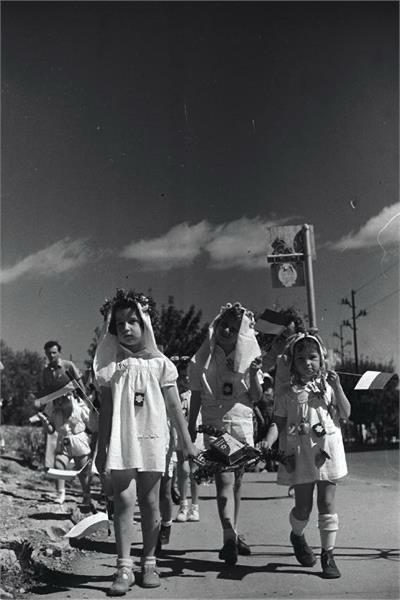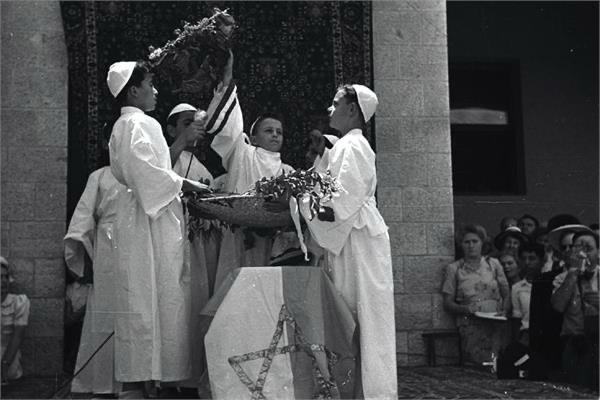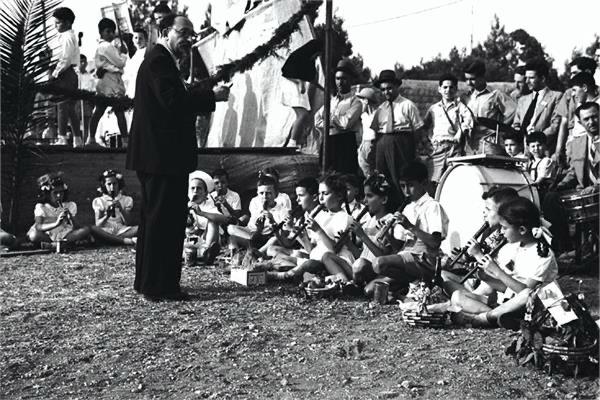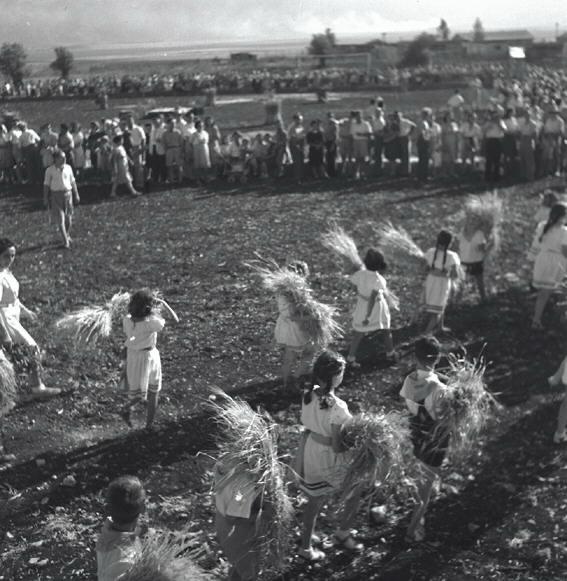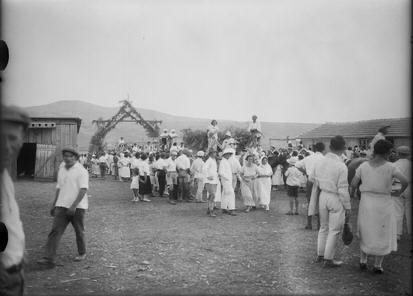
Long before dairy and gourmet cheese products from the supermarket, Shavuot was a communal celebration centered around fresh harvest brought directly from the fields. In pre-state Israel, Chag HaBikkurim (the Festival of First Fruits) was a celebration of land and community, where children, pioneers, teachers and musicians gathered together around the harvest, wheat stalks and the shared hope of building a new life in the Land of Israel.
Ahead of Shavuot, Keren Kayemeth LeIsrael–Jewish National Fund (KKL-JNF) is unveiling a series of previously unseen rare photographs from its Photo Archive, all taken before the establishment of the State of Israel, offering a glimpse into the days of the early Jewish state.
The photographs focus on the way Chag HaBikurim was celebrated in Israel before 1948. Taken in Kibbutz Geva, Jerusalem and Ramat Yohanan, the images capture small moments from a much larger celebration: children dressed in white marching in the Bikurim parades, girls wearing flower wreaths on their heads, young musicians playing violins before gathered crowds, courtyards decorated with branches and holiday symbols, and residents of the Jezreel Valley coming together to celebrate the bringing of the first fruits.
One photograph from Geva, taken in 1926, shows Jezreel valley workers gathered around a decorated ceremonial gate. The photographs from Jerusalem in the 1940s show kindergarten children and students symbolically giving KKL-JNF harvest during Chag HaBikurim celebrations, while an image from Ramat Yohanan documents a large Shavuot celebration in an open field, with children carrying bundles of wheat stalks.
The photographs are more than just a nostalgic documentation of the holiday celebration. They reflect a period in which Shavuot took on a national-Zionist meaning alongside its traditional religious significance, becoming an educational and social tool for strengthening Zionist identity and deepening the connection between the nation and the land.
Efrat Sinai, Director of Archives at KKL-JNF, said: “These photographs allow us to look back at the moments in which Israeli culture was taking shape before the establishment of the state. They capture the excitement, the festive atmosphere and the central role Shavuot played in the lives of the people living in Israel at the time. As part of the archive’s tradition, we are proud to reveal photographs each year that have never been publicly displayed before, and to share with the public small yet moving chapters from the visual history of the land. Beyond the beauty of the images themselves, they also reflect the way an ancient holiday took on new meaning in the Land of Israel.”