Emergency Campaign to Save Central Israeli Forests - Interim Summary

Project 22437 – Eshtaol Forest and Park Ayalon-Canada

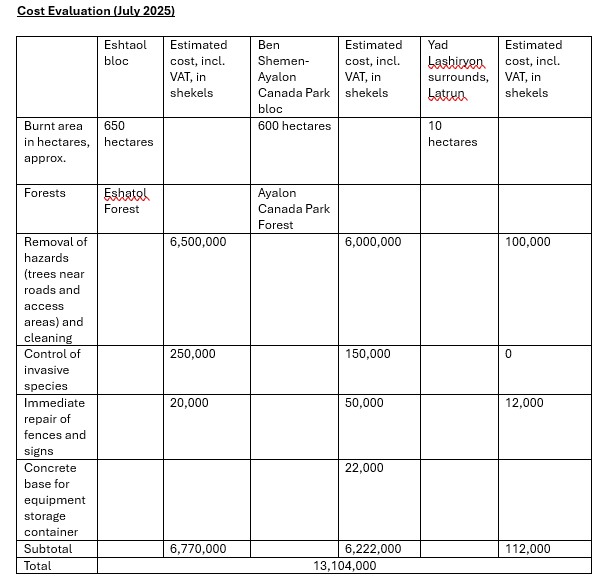
In May 2025, some 2,000 hectares (or 5,000 acres) of forest and open space in central Israel were burnt, including some 1,500 ha. (3700 acres) of KKL-JNF forest land:


In Eshtaol Forest, about 760 ha. were burned, of these:

345 ha. were burned on 23.5.25

412 ha. were burned on 30.5.25


In Ayalon-Canada Park, 610 ha. were burned, all on 30.5.25.


The rehabilitation plan includes:

  • Treatment and removal of burnt trees
  • Removal of dangerous hazards
  • Pruning for safety
  • Regulating flow channels and preventing erosion
  • Repairing access routes
  • High-density plantings in damaged recreation and leisure areas
  • Treatment of regenerating pine seeds
  • Planning fire lines
  • Establishing firebreaks
  • Perennial care of invasive species
  • Wildlife and vegetation surveys


Priorities and implementation were determined by a steering team of professionals from relevant fields. The rehabilitation process is expected to continue for 10-15 years, in gradual stages, based on surveys and insights gathered along the way, in accordance with the policy paper Rehabilitation after Extreme Events (2021) of the KKL-JNF Forestry Department.


Stages of Rehabilitation (Forestry Department, KKL-JNF).


Stage 1 – immediate (within a year after the event)

  • Mapping the burn area and the extent of the damage
  • Treatment of safety and other hazards
  • Removal of hazardous trees
  • Treatment of invasive species


Stage 2 –  intermediate (1-4 years after)

  • Continued treatment of other affected areas
  • Preparation of an integrated plan for forest management and long-term rehabilitation
  • Surveys, monitoring, area designation and prioritization, establishing firebreaks
  • Plantings


Stage 3 – long term (4-20 years after)

  • Completion of infrastructure repairs
  • Implementation of the forest management plan (detailed planning and execution of vegetation rehabilitation across the entire forest area, based on the principles of the overall plan).


Note: The emergency campaign currently focuses on Stage 1
Rehabilitation activities until now:

  • About 70% of the areas defined as “highly urgent” have been treated
  • Immediate hazards have been removed
  • In preparations to develop a plan to manage the remaining plots and plan new firebreaks
  • Maintenance of roads
  • Planning the treatment of invasive species
  • Planting plan – will be based on the 2026 surveys and will be prepared towards the winter of 2027
  • Renewed growth and flowering have been observed.

Eshtaol Forest

A plan is being developed for follow-up treatments on secondary roads.


Ayalon-Canada Park

  • Rehabilitation is complex due to managing the park’s opening to the public
  • Planned action: to create a leisure and tourism area in the heart of the park, and continuing rehabilitation work on its periphery. A work plan will be developed.
  • Mine clearance – carried out using a dedicated demining system, to be completed before the park opens.

Nature strips along Road 1

  • Removal of burnt trees in cooperation with Netivei Israel (Israel Roads)
  • KKL-JNF will treat invasive species and remove burnt trees
  • This activity has become a focus for donation in the framework of Project 22437.

Plan for Treatment of Burnt Trees (2026):
Recommendation: Treatment of enclosed areas (narrow, small, and between roads) and areas designated for future firebreaks.
Discussion on the reallocation of firebreak zones in the Eshtaol Forest and Ayalon-Canada Park.
The steering committee convenes once every 4 – 6 weeks.


Attachments: